
Cirencester Park Visitor Map
The South East of Cirencester Park sits close to the heart of Cirencester. Visitors can enter on foot from the town centre by way of Cecily Hill Gates, leading onto the iconic Broad Avenue. There are walking paths to explore, dotted with follies and far-reaching vistas.
Not to be missed is The Old Kennels with its day and evening dining, a nature-inspired play area, a dog wash, micro-brewery and shops. Park visitors can use The Old Kennels Car Park
Explore with our map below by clicking on the point of interest. On mobile devices, view in landscape; you can zoom into points of interest. Timings given in brackets are indicative.
Important Notice for Dog Walkers: Cirencester Park is dog-friendly but it is part of an active working Estate. Livestock are in fields, areas are in conservation schemes, protected wildlife roams freely. There is also varied leisure and farm activity. Due to the delicate balance of ensuring the Park, its woodlands, paths and roads are safe for all, dog walkers are requested to:
- Stay on the indicated routes only.
- Please keep your dog on a lead where shown, and under close control at all times.
- Clear up after your dog.
- Report any missing dogs, or incidents involving dogs to the Estate Office as promptly as posssible.

The Mansion
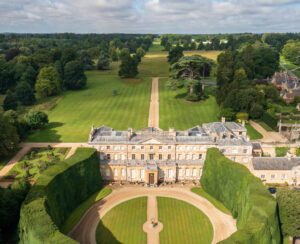
Enjoy a visit of this beautifully situated stately home in the heart of Cirencester. ‘The Mansion’ as it is locally known, is full of history, beautiful paintings and portraits including the notable commission by the 3rd Earl Bathurst of The Duke of Wellington riding his war horse ‘Copenhagen’, by Sir Thomas Lawrence.
Open on selected days only, tickets for a guided tour of The Mansion include a visit to the state rooms followed by refreshments. For information and tickets, read here.
- 1 of 13
The Old Kennels

In the 1840s, the 4th Earl Bathurst made improvements and alterations to the Park to include a range of kennels and cottages; originally built to house hounds and horse up until 1963, the Grade II listed limestone buildings and outbuildings have been used for liveries, as mechanic's workshops and houses.
Now The Old Kennels is home to Roots+Seeds Kitchen Garden, open for day and evening dining as well as offering locally-sourced treats from its Deli. Children can enjoy the nature-inspired play area or a visit to the kitchen garden.
As well as shops, a micro-brewery and a dog wash, The Old Kennels also hosts craft markets and events.
The Jubilee Community Arboretum at The Old Kennels is the perfect spot for a picnic. Open 08.00–17.00 daily, free of charge.
- 2 of 13
Cecily Hill Gate

Cecily Hill Gates and Screen (1856) is the entry point on foot from Cirencester town centre, leading to the principal ride in Cirencester Park: the Broad Avenue. The Grade II listed wrought-iron gates bear the Bathurst family crest.
It is believed that a Saxon settlement was once centred around Cecily Hill, to the northeast of the abandoned Roman town of Corinium.
Today Cecily Hill is one of the prettiest residential streets in Cirencester. The imposing castle-like barracks by the Gates were built in 1857 to house a military armoury; they are now commercial buildings.
There is limited public parking on Cecily Hill; the closest car parks are in the town centre or at The Old Kennels.
Cirencester Park is open daily 08.00–17.00. For information on Passes and Tickets, see here.
- 3 of 13
The Queen Anne Monument
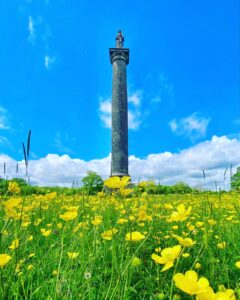
The 1st Earl won the favour of Queen Anne who visited in 1708. The Monument was subsequently erected in 1741 after a visit from the Prince of Wales as a symbol of Lord Bathurst’s admiration for the monarch.
The finely worked limestone is in the style of a Roman Doric column; it is 50 feet high with the statue of Queen Anne standing on a square plinth.
The landscape surrounding it is being gradually restored with tree clumps to create vistas, some dating from the 18th century and some from WWII plantations. During WWII, the U.S. Army established a field hospital here; its remains can be seen if walking to and from the Tennis & Cricket Club.
From here is a view to the rear of The Mansion with the tower of the Parish Church of St John Baptist beyond. To the West through the woodland is Seven Rides and the Pope’s Seat.
Walking North brings you to the top of Broad Avenue near the Stone Pillars (c.5 mins); walking North-East towards the Tennis & Cricket Club you will return part way down the Broad Avenue (c.10 mins), or to Windsor Walk to reach The Old Kennels (c.15 mins).
Dogs may be off lead, under control in the grassed area. The area may close from time to time for events such as The Cotswold Show in July.
- 4 of 13
The Hexagon

The Hexagon (1736) is a Grade II* listed classical covered seat designed by the 1st Earl Bathurst. The six-sided Georgian structure has limestone walls and a roof laid with Welsh slate, with a simple limestone ball finial at its apex. Originally a meeting place of 3 vistas and 3 smaller walks, from here you could once see more follies: The Horse Temple at the end of Windsor Walk and Hartley's Temple at the conservation pond at Deer Park School.
Today you can still enjoy the view down the lime-tree avenue Windsor Walk, which leads to The Old Kennels for Roots+Seeds Kitchen Garden, the Jubilee Arboretum Picnic Area and children’s play area (circa 5 minutes walk).
Continue up the Broad Avenue to reach the Stone Pillars (10 mins), and on to the Pope’s Seat (15 mins). Or, to the Queen Anne Monument, via the Cricket Club (10 mins).
- 5 of 13
The Commemorative Coronation Carving
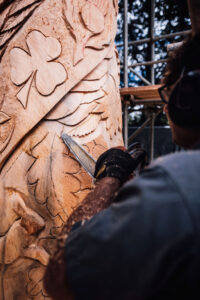
To celebrate His Majesty the King's Coronation and as a legacy piece for Cirencester Park, The Bathurst Estate commissioned a failing Cedar tree to be turned into a commemorative carving. The tree, located off the Broad Avenue was approximately 150 years old and had come to the end of its natural life.
Read more.
- 6 of 13
The Broad Avenue
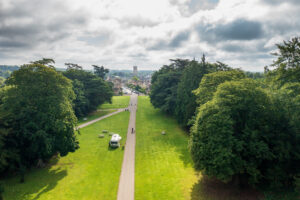
The Broad Ride, which includes the Broad Avenue, stretches five miles from the Park gates at the main entrance on Cecily Hill to the Golden Valley at Sapperton, outside of the Park. The 3rd Earl Bathurst was a friend of the Duke of Wellington and it is thought that the commemorative planting was carried out to mark the victory of the Battle of Waterloo in 1815, as a promenade into the Park from Cirencester.
The trees you can see today were planted to include horse chestnut, beech, elm and oak which in turn add variety to the yews and other conifers which dominated the landscape originally. Emphasis was placed on the seasonal colouring for year-round enjoyment.
An ongoing restoration project will see diseased and aged horse chestnut trees replaced with small leaved lime trees which are less likely to be affected by disease. Their smaller canopy will maintain the ‘broad’ avenue aspect in line with the 3rd Earl’s original vision. Small leaved lime are also a native species attractive to pollinators and provide an excellent habitat for insects and birds.
Today, you can enjoy leisurely walks along the Broad Avenue taking in the natural landscapes and garden buildings and monuments of the Hexagon, Pope’s Seat, Queen Anne Monument, as well as a visit to The Old Kennels and the Jubilee Community Arboretum.
- 7 of 13
Windsor Walk

Named as a connection to the Royal Court and London, Windsor Walk is lined with Lime Trees and stretches a short distance towards the Broad Avenue from the Tetbury Road, at the Windsor Walk gate and The Old Kennels (c. 5 mins).
The tree line opens at the intersection with the Main Avenue, with views to the Mansion and its Home Park to one side, and the Queen Anne Monument to the other. At this point, Windsor Walk passes over a ha-ha at Fulham Bridge. You may spot the Earl and Countess Bathurst's Gloucester cattle in Home Park.
The ha-ha runs along one side of Windsor Walk, a commonly used landscape feature of 18th century park, which is a recess in the landscape to act as a fence. Here, the ha-has stopped the deer of the Deer Park from escaping.
- 8 of 13
Stone Pillars
You are at the top of the first mile of the Broad Avenue from Cecily Hill marked by two Stone Pillars either side of the Avenue.
Erected in the early 18th century and now Grade II listed, they are made from limestone ashlar, standing approximately 12ft high, each with a moulded stone cornice and facetted cap.
Further along the Broad Ride, towards Pope’s Seat, on the edges of the grass ride and woodlands, you may spot two smaller stone pillars, likely used as avenue markers when laying out the Park. These are affectionately known as Pepper Pots.
From this point, there are walks either side through the woodlands and along the grassed area of the Broad Ride towards Pope’s Seat (5 mins), plus out to the South towards the Queen Anne monument (5 mins).
Dogs must be kept on the lead in the woodland walks. Dogs are not permitted on the grassed area of the central Broad Ride. Please be alert to horse riders.
- 9 of 13
Tennis & Cricket Clubs
The Cricket Club was formed in 1862. The clubhouse, refurbished in 2016, is one of the most picturesque in the country in terms of its location and setting. The clubhouse was used for archery and almost certainly a former deer shelter. It is situated next to all-weather tennis courts, making this a popular sporting venue for many local clubs and players.
To reach The Old Kennels, the Jubilee Community Arboretum, and the toilet and café facilities (c. 5-7 minutes), join Windsor Walk at Fulham Bridge.
- 10 of 13
The Beano Cafe

Lady Bathurst's converted American Airstream is located a short walk from Cecily Hill Gates and serves the best hot chocolate in town, alongside teas and barista coffees and a selection of locally-made cakes and icecream, as well as treats for your 4-legged friends.
Open daily during Park hours.
- 11 of 13
Seven Rides and Pope's Seat

The 1st Earl Bathurst and Alexander Pope, a prominent English poet in the early 18th century, were great friends. Pope visited many times to advise Lord Bathurst on design of both the lay-out of Cirencester Park and the follies and monuments within.
The Pope’s Seat was designed by Pope and is a small Grade II* listed pavilion, neoclassical in design, with limestone finely cut or worked stone (ashlar) and decorative contrast (vermiculated rustication) to the front, coursed squared limestone to the sides and rear and finished with a slate roof. To the front there is a temple like porch, known as distyle Doric portico, with flanking screens and ornamental supporting columns (clasping pilasters), with bands of similar rustication and ball finials. Inside there are roughcast walls, a limestone floor and iron bound benches, which are a later addition for rest and shelter.
Commanding seven splendid views of woods and avenues (Seven Rides), one leading to Queen Anne Monument (15 mins), Pope’s Seat is an ideal spot to appreciate the scale of the Park and enjoy the tranquillity far from the Town centre and any main roads. Facing South, with Pope’s Seat behind, on a clear day you will be able to see the spire of Kemble church in the far distance.
The veteran tree lines along some of the rides include Sycamore, Beech and Sweet Chestnut.
Dogs are not usually permitted on the grass area of Seven Rides; please follow the dog walking routes as indicated.
- 12 of 13
Fulham Bridge

Fulham Bridge sits at one edge of an original Deer Park. To the East, in the direction of the Queen Anne monument, this area was used during the Second World War by the 188th U.S. Army as a General Hospital. Today, much of the site of the hospital is now Deer Park School (established in 1966) and Cirencester College, along with the Caravan Park and Motorhome Club.
When the hospital was constructed, trees needed to be felled and landscape cleared to make way for the hospital buildings and Nissen huts. In the 1990’s, most of the wartime footings were removed and the landscape around the Queen Anne’s monument restored. Today, the Estate continues with landscape restoration, including the addition of the Jubilee Community Arboretum planted in 2023, behind The Old Kennels.
- 13 of 13